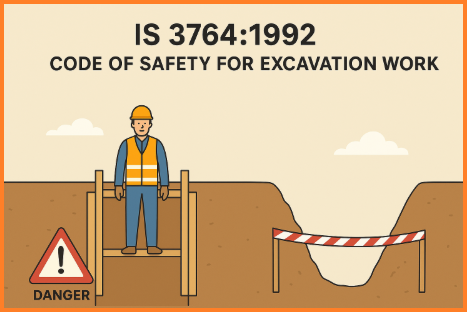
Excavation is one of the most fundamental and hazardous activities in construction. Whether for trenches, foundations, road cuttings, or utility pipelines, excavation exposes workers to risks, including cave-ins, falling material, hazardous gases, and accidents involving machinery. Recognizing these dangers, the Bureau of Indian Standards (BIS) published IS 3764:1992 – Code of Safety for Excavation Work, laying down safety measures to minimize accidents and safeguard workers’ lives.
1. Scope of the Standard
The standard applies to excavation works such as:
- Trenches, test pits, cellars, borrow pits, canal and road cuttings.
- Excavations where sides are not simultaneously trimmed to a stable slope.
Exemptions:
- Trenches less than 1.5 m deep.
- Trenches where no entry of persons is required.
- Mechanically excavated and backfilled pipeline trenches.
2. Responsibilities
Supervisors and Foremen
- Must be competent, experienced, and responsible for enforcing safety rules.
- Inspect excavation sides regularly, especially after rain or storms.
- Ensure underground structures (pipes, cables, sewers, etc.) are identified before digging.
- Provide first-aid facilities at site.
Workers
- Must use personal protective equipment (helmets, boots, gloves, safety belts).
- Should be properly trained and briefed on hazards.
- Must refuse unsafe work and immediately report hazards to supervisors.
3. Shoring, Timbering, and Sheet Piling
Proper support systems are essential to prevent trench collapse:
- Shoring & Timbering:
- Mandatory for trenches deeper than 1.5 m in soil and 2 m in unstable rock.
- Members such as sheathing, wales, struts, and cleats must be placed correctly.
- Timber or other strong materials should be used.
- Sheet Piling:
- Recommended when slopes are impractical, nearby structures exist, or soil is fluid.
- Can be timber, steel, concrete, or composite piles.
- Inspection:
- Must be done before work begins, after blasting, and following rain/storms.
4. Excavated Material and Berms
- Excavated earth must be kept at least one-third of trench depth away from the edge (minimum 1 m).
- Tools, wheelbarrows, and other equipment should be stored away from edges to prevent falling.
- Materials must not be piled against walls or near power lines.
5. Machinery and Vehicles
- Heavy equipment should not operate closer than the depth of the trench (or 6 m if trench >6 m).
- Trucks must not be backed near trench edges; stop-blocks should be provided.
- Power shovels and draglines can destabilize trench sides – their use must be closely monitored.
6. Access, Escape, and Barricading
- Pathways & Gangways: Minimum width of 75 cm, non-slippery, with guardrails if elevated.
- Ladders: At least one ladder per 30 m length (1.5 m spacing in hazardous work). Must extend 1 m above trench edge.
- Fencing & Guards: Trenches accessible to the public must have barricades and danger signage.
- Lighting & Signals: Adequate lighting for night work and warning signals for vehicles and pedestrians.
7. Special Hazards
a) Loose Side Material
- Remove loose stones, unstable earth, and projecting clumps.
- Prevent workers from working directly one above the other.
b) Gases and Fumes
- Ensure oxygen content is ≥19% and carbon dioxide ≤1%.
- Ventilate trenches where gases may accumulate.
- Combustion engines inside trenches must have safe exhaust systems.
c) Insects, Snakes, and Poisonous Plants
- Workers should be provided protective gear, repellents, and first-aid remedies.
- Training for identification of poisonous plants is essential.
d) Overhangs and Slopes
- Remove overhangs before further excavation.
- Break down unstable slopes and prevent workers from entering danger zones.
e) Water and Weather
- Watch for water saturation after rainfall.
- Freezing and thawing cycles may loosen trench walls.
8. Safety Provisions
- Lifelines & Safety Ropes: Workers entering hazardous trenches must wear safety belts with lifelines anchored securely.
- Shelters: Provide safe shelters for workers away from trench walls during breaks or storms.
- Supports for Foundations: Adjacent foundations must be supported with bracing or underpinning.
- Walkways & Bridges: Guardrails required where depth exceeds 2 m.
9. Common Hazards in Excavation
The code highlights key risks:
- Quicksand requiring close sheathing.
- Water saturation weakening trench walls.
- Vibrations from machinery or traffic.
- Adjacent fills or surcharges from nearby structures and heavy loads.
Conclusion
The IS 3764:1992 – Code of Safety for Excavation Work is a comprehensive guideline that emphasizes planning, supervision, worker training, protective systems, and emergency preparedness. Following these safety principles significantly reduces accidents, protects workers from fatal cave-ins, and ensures smooth progress of construction projects.
For contractors, engineers, and safety officers, strict compliance with this standard is not only a legal requirement but also a moral responsibility towards safeguarding human life in hazardous excavation operations.