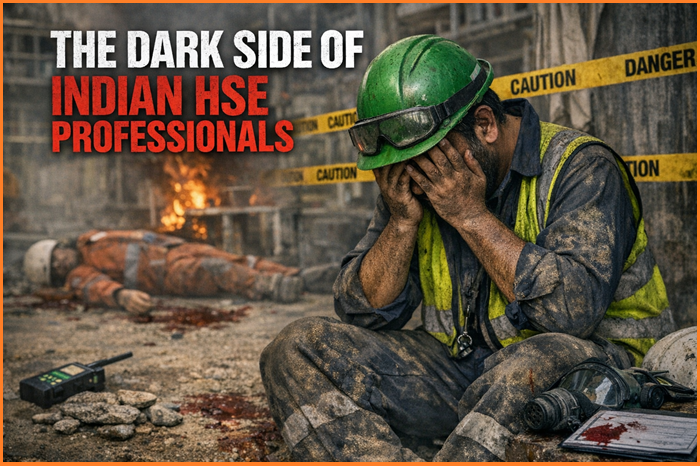
HSE professionals play important role in protecting workers lives and ensuring compliance in high-risk industries like construction, oil & gas and manufacturing. In India, where a vast workforce operates under challenging conditions, their role becomes even more critical. However, like any profession shaped by systemic pressures the HSE domain also has a “darker side” that is rarely discussed openly.
This article explores some uncomfortable truths….not to criticize individuals, but to highlight systemic issues that hinder genuine safety culture.
1. Compliance Over Commitment
One of the most common issues is the tendency to treat safety as a tick-box exercise rather than a core value. Many organizations focus on paperwork….permits, checklists, and audits….while actual site conditions remain unsafe.
Studies indicate that safety in India is often seen as a regulatory obligation rather than a cultural priority, leading to superficial compliance practices.
As a result, some HSE professionals unintentionally become part of a system where documentation appears perfect, but real risks remain uncontrolled.
2. Pressure from Management
HSE professionals frequently face a conflict between safety and productivity. Tight deadlines, cost constraints and commercial pressures often push management to prioritize delivery over safety.
Globally, safety professionals report being pressured to compromise safety standards or underreport incidents to protect company reputation or meet KPIs.
In such environments, even well-intentioned HSE officers may soften their stance, leading to diluted enforcement and increased risk exposure.
3. Underreporting and Data Manipulation
Accurate reporting is the backbone of a strong safety system. However, in practice, near-misses and minor incidents are often hidden to maintain “zero incident” records.
This issue is linked to a larger systemic problem…lack of accountability and underreporting of workplace accidents, especially in smaller or unorganized sectors.
When data is manipulated, organizations lose the opportunity to learn from failures, and the risk of major accidents increases significantly.
4. Weak Enforcement and “Understanding Culture”
India has a solid legal framework for occupational safety, but implementation and enforcement remain inconsistent.
Reports have highlighted instances where inspections are conducted on an “understanding” basis, compromising the effectiveness of safety audits.
This creates a dangerous environment where non-compliance becomes normalized, and HSE professionals may feel powerless or even complicit.
5. Lack of Authority and Independence
In many projects, HSE personnel lack real authority. They may report to project managers or contractors whose priorities are driven by cost and timelines.
This structural limitation results in:
- Ignored safety recommendations
- Delayed corrective actions
- Token safety meetings without impact
When safety professionals are not empowered, their role becomes advisory rather than authoritative—reducing their effectiveness.
6. Inadequate Competency and Training Gaps
While India has many skilled HSE professionals, the rapid growth of industry has led to variations in competency levels. In some cases, individuals enter the field with limited practical knowledge or rely on theoretical certifications alone.
A lack of awareness and training among both workers and supervisors further complicates the situation.
This gap can lead to poor risk assessments, ineffective toolbox talks, and weak incident investigations.
7. Contractor and Multi-Vendor Complexity
Indian industrial projects often involve multiple contractors, subcontractors, and vendors working simultaneously. Each comes with different standards, training levels, and safety cultures.
This fragmented environment creates confusion in accountability and increases risk exposure if not controlled under a unified safety system.
HSE professionals often struggle to enforce consistent standards across diverse teams.
8. Safety Viewed as a Cost Center
A harsh reality in many organizations is that safety is still seen as an expense rather than an investment.
Cost-cutting may lead to:
- Compromised PPE quality
- Reduced training programs
- Delayed maintenance
- Insufficient manpower for supervision
This mindset not only weakens safety systems but also puts HSE professionals in constant conflict with management priorities.
Beyond the “Dark Side”
It is important to understand that these issues are largely systemic, not personal failures. Most HSE professionals genuinely aim to protect lives, but they operate within constraints such as organizational pressure, weak enforcement, and cultural challenges.
To overcome these issues, organizations must:
- Empower HSE professionals with authority
- Promote transparent reporting culture
- Invest in training and competency
- Treat safety as a leadership priority, not a formality
Ultimately, the true success of HSE is not measured by zero reports, but by real risk reduction and genuine safety culture on the ground.